The Australian Physical Activity guidelines are in place to promote healthy habits, prevent disease, reduce sedentary behaviour and improve overall wellbeing (Australian Government Department of Health and Aged Care, 2021). According to the Australian Institute of Health and Welfare, the majority of Australian adolescents are not meeting their daily physical activity needs. In fact, 77% of primary school aged children are not achieving the recommended 60 minutes of daily moderate to vigorous physical activity (Australian Government Department of Health and Aged Care, 2021). This is where Max Moves comes in. An evidence based physical activity intervention that acts as a brain boost within the standard classroom setting. Combating sedentary behaviour and improving overall student wellbeing by getting kids moving daily for short 15-minute blocks (Bacon & Lord, 2021; Daly‑Smith et al., 2018).
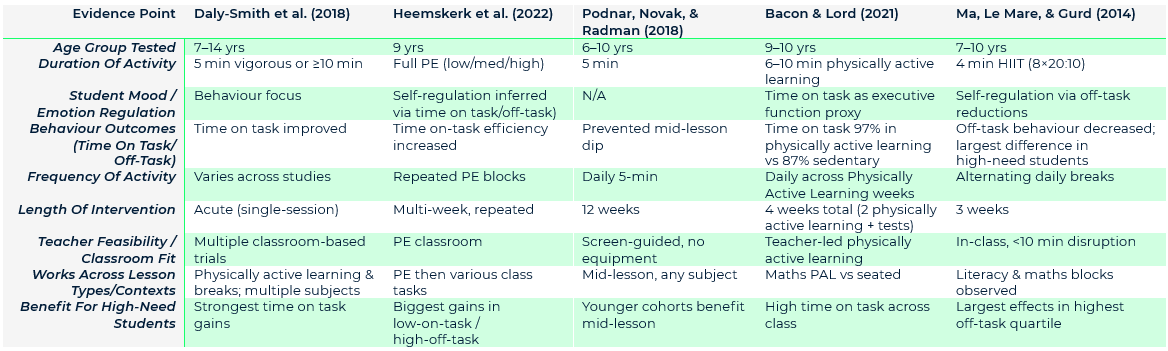
Backed by evidence, Max Moves delivers movement-based challenges that directly focus on classroom behaviour, consistently improving time‑on‑task, reducing off‑task behaviours, and supporting students who struggle the most (Daly‑Smith et al., 2018; Heemskerk et al., 2022; Ma et al., 2014). These behavioural gains are closely connected to improved mood and emotion regulation, with studies showing that short bursts of physical activity help students reset, regulate and re‑engage more effectively with their learning (Heemskerk et al., 2022; Podnar et al., 2018).
Physically active learning shows that integrating movement into lessons maintains or enhances learning outcomes (never hindering it) while improving the cognitive conditions needed for retention, problem solving and working memory (Bacon & Lord, 2021; Daly‑Smith et al., 2018). When students are more attentive, emotionally regulated and ready to learn, academic outcomes naturally improve (Bacon & Lord, 2021; Daly‑Smith et al., 2018).
By embedding movement daily, Max Moves mirrors research showing that consistency strengthens cognition and behaviour in primary school aged students (Podnar et al., 2018; Bacon & Lord, 2021). And because sustainable change requires repetition, Max Moves is intentionally designed as a habit‑building program over a 6‑week period. This reflects research demonstrating that multi‑week interventions return the strongest gains in focus, regulation and learning readiness (Podnar et al., 2018; Ma et al., 2014).
Together, these elements position Max Moves as a credible, research‑aligned solution that improves behaviour, enhances mood and emotional regulation, boosts learning outcomes, promotes daily physical activity and builds long‑term habits, all within the natural rhythm of the classroom (Daly‑Smith et al., 2018; Bacon & Lord, 2021; Heemskerk et al., 2022; Podnar et al., 2018; Ma et al., 2014).
References
Australian Government Department of Health and Aged Care. (2021). Physical activity and exercise guidelines for all Australians: Children and young people (5 to 17 years). https://www.health.gov.au/topics/physical-activity-and-exercise/physical-activity-and-exercise-guidelines-for-all-australians/for-children-and-young-people-5-to-17-years?language=en
Bacon, P., & Lord, R. N. (2021). The impact of physically active learning during the school day on children’s physical activity levels, time on task and learning behaviours and academic outcomes. Health Education Research, 36(3), 362–373. https://doi.org/10.1093/her/cyab020
Daly‑Smith, A. J., Zwolinsky, S., McKenna, J., Tomporowski, P. D., Defeyter, M. A., & Manley, A. (2018). Systematic review of acute physically active learning and classroom movement breaks on children’s physical activity, cognition, academic performance and classroom behaviour: Understanding critical design features. BMJ Open Sport & Exercise Medicine, 4, e000341. https://doi.org/10.1136/bmjsem-2018-000341
Heemskerk, C. H. H. M., Sumatic, M., Strand, S., & Malmberg, L.-E. (2022). Individual differences in the effects of physical activity on classroom behaviour. Frontiers in Education, 6, 812801. https://doi.org/10.3389/feduc.2021.812801
Ma, J. K., Le Mare, L., & Gurd, B. J. (2014). Classroom-based high-intensity interval activity improves off-task behaviour in primary school students. Applied Physiology, Nutrition, and Metabolism, 39, 1332–1337. https://doi.org/10.1139/apnm-2014-0125
Podnar, H., Novak, D., & Radman, I. (2018). Effects of a 5‑minute classroom-based physical activity on on‑task behaviour and physical activity levels. Kinesiology, 50(2), 251–259. https://doi.org/10.26582/k.50.2.17